Wednesday, March 07, 2012

The US seeks the extradition of MegaUpload founder Kim Dotcom...

United States of America has extradition treat...
Image via Wikipedia
Image representing Megaupload Limited as depic...
Image via CrunchBase


Enhanced by Zemanta

Monday, March 05, 2012

Has the rule of law been lost in Fiji - yes says undercover mission...

 
BREAKING NEWS
Auckland Council puts brakes on port expansion into harbour..
 
A secret fact-finding mission to Fiji has found citizens have no legal way of challenging any of the Government's decisions, and the rule of law and independence of the judiciary has all but vanished.
A return to the rule of law is hamstrung by the benefits members of the ruling regime enjoy, and by state-sanctioned intimidation of dissenters.
In November members of the Law Society of England and Wales visited Fiji on an undercover mission and interviewed past and present lawyers, judges, diplomats and people in non-government organisations.
Their report Fiji: The Rule of Law Lost found a system of governing that was not "transparent, certain, predictable, accountable or democratic".
Foreign Minister Murray McCully said the report was "not very encouraging" but pointed to steps Fiji was taking towards holding elections.
These included a commitment to a public consultation process and a voter registration programme.
"This is a pivotal point in time," he said. "The acid test in the eyes of the international community would be what steps take place now, both in terms of freedom of assembly and media freedom, but also in terms of the public consultation process and whether it will engage all stakeholders.
Mr McCully said the jury was out and he wanted to keep an open mind.
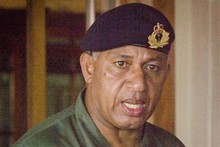
Fiji has been under military rule since 2006, when Frank Bainimarama seized power. He has promised elections in 2014.
The report found that judges and prosecutors had been fired without reason, the state had censored the media and the regime abused its power to intimidate its critics.
"The judges dismissed in April 2009 were given no reasons, no notice and no compensation for loss of office," the report said. "It is apparent that their sin was to comply with their oath of office and to act independently rather than any misconduct. It is difficult to conceive of a more obvious attack on judicial independence."
Many of the state's prosecutors were also replaced with lawyers from Sri Lanka on short-term contracts, the report said.
The report called all national law societies and bars to lobby governments to press for measures to be taken by the Fiji Government to ensure a return to the rule of law.
Labour's foreign affairs spokesman Phil Goff said the report was damning, but he did not think harsher sanctions on Fiji were the answer.
Economic sanctions hurt ordinary people without necessarily having the desired impact on the regime.
INTIMIDATION
* Dorsami Naidu, president of the Fiji Law Society and vocal critic of the Government, was detained by police for 24 hours after protesting peacefully outside a High Court building.
* Hemendra Nagin, a lawyer who led a petition against the forcible removal of the Chief Justice in 2007, was fined $15,000 for professional misconduct.
* Human rights lawyer Imrana Jalal was charged under a decree that did not come into force until two months after she was charged. She was eventually acquitted, but lives in exile.
* Graffiti artists have been charged with sedition.
Enhanced by Zemanta

Sunday, March 04, 2012

A tearful Putin is president of Russia once more...

THE GRAND KREMLIN PALACE, MOSCOW. President Pu...
Image via Wikipedia
Opposition leaders denounce 'illegitimate, untransparent' polls in which former PM won more than half of votes. Whatever their opinions may be, whatever the claims are: Vladimir Putin is president of Russia once more...
MOSCOW - Mr Vladimir Putin triumphed in Russia's presidential election and, tears rolling down his cheeks, called his victory a turning point that had prevented the country falling into the hands of enemies.

Mr Putin's opponents complained of widespread fraud, refused to recognise the results and said they would press ahead today with the biggest protests since he rose to power 12 years ago.

But former KGB spy Putin said yesterday he had won a "clean" victory and was on course to return to the Kremlin after four years as Prime Minister with almost 65 per cent of votes, partial results showed.

"I promised you we would win. We have won. Glory to Russia," Mr Putin, dressed in an anorak and flanked by outgoing President Dmitry Medvedev, told tens of thousands of flag-waving supporters at a late-evening victory rally under the red walls of the Kremlin.

Denouncing attempts to "destroy Russia's statehood and usurp power," he said: "The Russian people have shown today that such scenarios will not succeed in our land ... They shall not pass!"

The crowd at one point chanted: "Putin! Putin! Putin!" Some danced to keep warm and drank vodka from plastic glasses, with empty bottles crunching underfoot.

A spokesman later said Mr Putin had wept real tears at the victory rally but said they were caused by the biting wind.

It was a defiant and angry speech which left Mr Putin, 59, on collision course with the mainly middle-class protesters in Moscow and other big cities who have staged huge rallies since a disputed parliamentary poll on Dec 4.

Two exit polls showed Mr Putin with 58 to 59 per cent of the votes and incomplete results showed him winning more than 64 per cent.

His nearest rival, Communist Party leader Gennady Zyuganov, had about 17 per cent of votes, and nationalist Vladimir Zhirinovsky, former parliamentary speaker Sergei Mironov and billionaire Mikhail Prokhorov were all below 10 per cent.

Mr Zyuganov said his party would not recognise the result and called the election "illegitimate, dishonest and untransparent". Liberal leader Vladimir Ryzhkov also said it was not legitimate.

The protest organisers, who see Mr Putin as an autocratic leader whose return to power will stymie hope of economic and political reforms, said their demonstrations would now grow.

Said journalist Sergei Parkhomenko, one of the leaders of the opposition protest movement: "He is forcing things to breaking point. He is declaring war on us. As a result the base of aversion to him is growing."

Despite the opposition, mainly among well-educated and relatively well-off young professionals, Mr Putin's support remains strong in the provinces and his victory had not been in doubt.

He showed his gratitude in late-night video links with supporters around Russia, including workers at a tank factory in the Urals town of Nizhny Tagil who have denounced the protests.

"You put in their places those people who went one step too far and insulted the working man," Mr Putin told them. "You showed who the Russian people are, the Russian working man, the worker and the engineer. You showed that you are a head higher than any layabout, any old windbag. This was for me the biggest present."

Mr Putin's clear victory - he avoided a runoff election by receiving more than 50 per cent of the vote - will enable him to portray his return to the post he held from 2000 until 2008 as strong public backing against the protesters, whom he has portrayed as a destabilising minority and pawns of foreign governments.

He will be inaugurated in May. REUTERS
Enhanced by Zemanta

Tuesday, February 28, 2012

Angelina's story: To sell genocidal humanitarin intervention war doctrine...

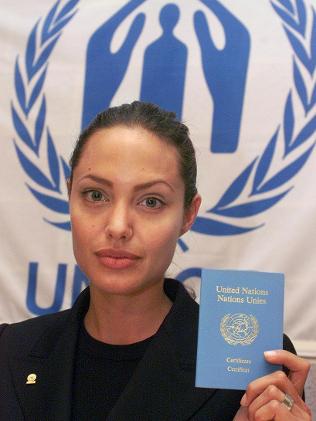
Angelina Jolie Conscripted To Sell Genocidal ‘Humanitarian Intervention’ War Doctrine

by Martin Iqbal
Updated Sunday 26 February, 2012. Click here to go to the update.
Angelina Jolie, Goodwill Ambassador to the UN and member of CFR, is now using her profile to promote NATO’s genocidal ‘humanitarian intervention’ war doctrine. In an interview with the Balkans branch of Al Jazeera (NATO’s ‘Ministry of Truth’), Jolie (whose father has been a staunch defender of George W. Bush and who also visited Israel to celebrate the 60th anniversary of the Nakba) promotes her new film ‘In the Land of Blood and Honey’, a pro-war propaganda set-piece centred around the ‘humanitarian intervention’.
Set in Sarajevo, Jolie’s directorial debut aims to justify NATO’s brutal butchery in Bosnia during the 1990s, and Jolie even specifically refers to Syria in her Al Jazeera interview. She puts forth a string of utterly hollow gripes about the inactivity of the ‘international community’ as civilians suffer and die. Jolie’s selective morality means she doesn’t once mention Libya – a nation now butchered, fractured, and transformed into a torture state by NATO’s genocidal ‘humanitarian intervention’; an estimated 100,000 innocent people slaughtered by the very same ‘international community’.
Most likely reading from her pre-defined talking points, Jolie even calls out Russia and China for using their veto powers against the ever benevolent ‘international community’ vis-à-vis Syria.
“I think Syria has gotten to a point, sadly, where some form of, certainly, where some sort of intervention is absolutely necessary.
It’s so disheartening, it’s so sad, it’s so upsetting, it’s so horrible, what’s happening…at this time we just must stop the civilians being slaughtered…when you see that sort of mass violence and murder on the streets we must do something. And I know that the countries in the region are pushing as well, so I feel that this is a good global effort, but then there are these countries that are choosing not to intervene and I don’t feel, I feel very strongly that the use of a veto when you have financial interests in a country should be questioned, and the use of a veto against a humanitarian intervention should be questioned.”
Listen from approximately 8 minutes and 20 seconds in:

Hollywood superstar Angelina ‘Humanitarian’ Jolie is now baying for Syrian blood. The worst part is, due to our pitiful culture of celebrity worship and braindead media consumption, this episode may do great damage to the months of hard work that truth-seekers have done to expose this genocidal doctrine of war.

Update: 26 February, 2012

Yet another celebrity has been conscripted to sell the war on Syria. This time it’s UK singer Joss Stone telling the BBC that “these stories have to be told” otherwise the “massacres will just get worse”.

Tuesday, February 21, 2012

Corruption in the Schapelle Corby drug case - 34 questions need answering concerning Govt complicity...

English: Prime Minister of Australia, the Hono...
Image via Wikipedia

  • Corby hung out to dry. Is she just expendable?
    :??:schapelle-corby
    34 Questions About Australia's Censored Corruption Crisis in the Schapelle Corby Case...
    During the last few weeks, every elected federal politician in Australia has received a series of emails from members of the public. Digital 'read receipts' prove that the vast majority have read them. Only two replied; with one of them, on behalf of a prominent Senator, stating that he "will not be initiating any further intervention into this matter".
    This is not remarkable, as literally dozens of emails on the same subject have met the same fate over the previous three months. What is remarkable, however, is that, de facto, the repeated response failures equate to open complicity with criminality and corruption.
    The Crimes of a State
    In July 2005, Australian citizen, Schapelle Corby, who was facing 20 years in an Indonesian prison, was awaiting her appeal. On 5th July, 2005, the then Australian Justice & Customs Minister, Christopher Ellison, discovered game-changing information: that Schapelle Corby's boogie board bag was the only one not scanned at Sydney airport. Three days later, he withheld this vital primary evidence from her lawyer. Six days later he withheld it again. AFP Commissioner Michael Keelty had the same information. So did Prime Minister John Howard. Schapelle Corby was never informed, and this critical evidence was never used to defend her. This is just one example. Let's take another.
    Schapelle Corby checked her bags in normally, without excess or fuss. The authorities later discovered that they were 5 kg overweight on the Qantas system. Despite a handy 4.2 kg of marijuana appearing in her bag on arrival in Indonesia, she was never informed. This vital primary evidence was again withheld, and never used to defend her. Read more:
    Acknowledgements: Simon Langford, Activist Post


http://www.activistpost.com/2012/02/34-questions-about-australias-censored.html

Kiwipete
Enhanced by Zemanta

Friday, February 17, 2012

How Rwanda managed to substantially cut poverty in six years...

Rwanda
This post has been corrected. See the note at the bottom for details.
The small African nation of Rwanda recently announced that it had cut poverty by 12% in six years, from 57% of its population to 45%. That equals roughly a million Rwandans emerging from poverty -- one of the most stunning drops in the world.
It's a remarkable achievement for Rwanda, which has emerged from civil war and a bloody ethnic genocide in the 1990s. How did it happen? The Times quizzed Paul Collier, director of the Center for the Study of African Economies at Oxford University, about the numbers.
Are there any doubts that the drop is real?
No doubts; I know the economics professor who did the data analysis, and he is highly experienced and painstaking, so it is genuine.
How did Rwanda cut its poverty so much?
There were one or two helpful events, notably the rise in world coffee prices, which pumped money into the rural economy, but, of course, overall the global economy since 2005 has not provided an easy environment for success. Hence, most of the achievement is likely due to domestic policies.
Rwanda is the nearest that Africa gets to an East Asian-style “developmental state,” where the government gets serious about trying to grow the economy and where the president runs a tight ship within government built on performance rather than patronage

Read more:

http://latimesblogs.latimes.com/world_now/2012/02/how-did-rwanda-cut-poverty-so-much.html

Friday, February 10, 2012

The dark web: Guns and drugs for sale on the internet's secret black market expose...


A silhouette of a man using a laptop

Related Stories


Out of reach of regular internet searches is the secretive online world known as the 'dark web' - anonymous, virtually untraceable global networks used by political activists and criminals alike.

"You have the availability of multiple dealers so you can compare products - and customers can review the dealer's product, too."

American student, David - not his real name - explains why he chooses to buy illegal drugs on the so-called 'dark web'.

"You don't have to go in front of a street dealer, where there might be a risk of violence," he adds.

And it is not just drugs which are available on this online black market. Fake passports, guns - even child pornography.
Anonymous drug dealers
The dark web is facilitated by a global network of computer users who believe the internet should operate beyond the supervision of law enforcement agencies.

The BBC's 5 live Investigates team found class A drugs and guns for sale

It allows users like David, and those who sell him drugs, to remain anonymous. Users often do not know the real identity of the fellow users they are dealing with, and it is very difficult - although not impossible - for authorities to track them.

5 live Investigates spoke online with a number of anonymous dark web users.

One told the programme "I feel much safer [online] than doing transactions in the real world. I used to sell drugs in the real world. Nowadays I almost strictly use the dark web for any drug transaction."

Another said: "If you're young and trying to find a contact for drugs harder than marijuana it is practically impossible without risking exposure and arrest."

Start Quote

We don't have enough courts, we don't have enough judges, and we don't have enough police officers to tackle the real scale of illegal behaviour on the internet”
End Quote John Carr Internet security adviser

Getting access to the dark web depends on users downloading freely available software, based on peer-to-peer file-sharing technology, which effectively scrambles the location of users and dark web websites.

It is not just a criminal domain, either - the dark web has proved a crucial tool in concealing the identity of political campaigners living in countries with oppressive governments.

It is said to have helped some of the organisers behind the Arab Spring protests.

That said, the potential for criminal enterprise is significant.

Researchers from the 5 live Investigates team successfully accessed the dark web, and made a purchase of the hallucinogen DMT - a class A drug, ranking it on a par with heroin and cocaine.

An extra layer of secrecy is added to the dark web by the use of Bitcoins - an electronic currency which is used legitimately by online gamers, but which can be used by criminals to mask their financial transactions.

Find out more

An illustration of binary code
Listen to the full report on 5 live Investigates on Sunday, 5 February at 21:00 GMT or download the 5 live Investigates podcast

After a wait of around 3 weeks a package arrived in the post with a Spanish postmark. Concealed between two thin strips of cardboard was a white powder.

Analytical Services International, at St George's University of London examined the drugs.

The lab test proved the powder was DMT - and that the dark web works.

We have no idea who sent the drugs to us. They have now been destroyed by the lab as possession of DMT can lead to a jail sentence of up to seven years.

Dealers of DMT can face a maximum life term in prison.

But what is being done to police the criminal activity that takes place on the dark web?

"Police officers on both sides of the Atlantic say the same thing," says John Carr, an internet security advisor to the British government and the United Nations.

Start Quote

Many people share the belief, myself included, that drugs should be legal and the dark web is that belief put into action”
End Quote 'David' Dark web user

"We don't have enough courts, we don't have enough judges, and we don't have enough police officers to tackle the real scale of illegal behaviour on the internet.

"What that means is increasingly we're going to have to look to technical solutions, we're going to have to look to the internet industry to help civil society deal with this really enormous problem the dark web has created," Mr Carr told the BBC.

"The police service is acutely aware of the large and growing problem of cybercrime and is actively working with police nationally and internationally along with the private sector in a bid to combat criminality on the web," says Deputy Assistant Commissioner Janet Williams, the lead on e-crime for the Association of Chief Police Officers.

Yet for all their efforts much of the illegal activity on the dark web remains beyond the reach of the police, and to some supporters of the dark web, its anonymity is its virtue.

They point to the protection it has offered to anti-government bloggers who spread the message of revolution during the Arab Spring.

And they argue that it continues to provide cover for dissidents who might otherwise face persecution in China.

For US student and dark web user David, it is about freedom of choice:

"Many people share the belief, myself included, that drugs should be legal and the dark web is that belief put into action."
Enhanced by Zemanta

Thursday, February 02, 2012

Nasa seeks gay astronauts for Mars Mission...

Colonel George D. Zamka, USMC, NASA astronaut
Image via Wikipedia
English: The NASA insignia. Español: Insignia ...
Image via Wikipedia
Mission To Mars
Mission To Mars (Image via RottenTomatoes.com)
English: Artist's rendering of a Mars Explorat...
Image via Wikipedia
List of female astronauts
Image via Wikipedia
NASA
NASA (Photo credit: Luke Bryant)
NASA
NASA (Photo credit: Luke Bryant)


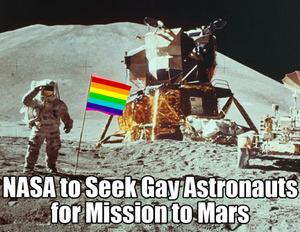
NASA has set a 30-year timeline for when it expects to land on the surface of Mars. However, one particular issue which up till now has been a topic of taboo, is the sexual desires of its crew. One potential solution has NASA turning to the gay community.

"There is a decision that is going to have to be made about mixed-sex crews, and there is going to be a lot of debate about it", says Paul Root Wolpe, a bioethicist at the University of Pennsylvania and advisor to NASA.

Enter: The modern homosexual.

Sexual urges are sexual urges and they'll need to be handled one way or another- so why not utilize a gay astronaut who, even if he or she was to fool around, ultimately would avoid a pregnancy.

"This could be a great opportunity in gaining further acceptance of the gay lifestyle on a worldwide scale", says Rick Michaels, founder of Homosexuals for Space Exploration (HSE). "Additionally, it would technically place Mars as the first gay-friendly planet."

"An intergalactic gayborhood, essentially", he added, pointing out that he and his partner have been long-time residents of Philadelphia's gayborhood.

Still dealing with the fallout from astronaut Lisa Nowak's February 2007 arrest for stalking and attempted murder, among other charges involving an astro-love triangle, NASA would need to approach the possibility of relationships among the crew.

NASA has already stated that divas and closet-dwellers will not be accepted into the program.

"All potential candidates must be 'out' and free of primadonna tendencies," says NASA rep Lenny N. Carl.

In addition to the sex issue, NASA must also figure out a way to handle the possibility of death. Previous missions could have an astronaut back on Earth within hours (courtesy of a Russian Soyuz space vehicle) since it was only a 220 mile trip back home, however a mission to Mars would take them 240,000 miles away from their favorite gravitational pull.

The mission to Mars will test the boundaries of human endurance as astronauts will be faced with extended exposure to radiation, the loss of muscle and bone, and the psychological challenges of isolation.


Actually facts used in this fine piece of literature were lifted from:
AP, "NASA Ponders Death and Sex on Mars Mission" WTKR.com
URL: http://www.wtkr.com/Global/story.asp?S=6455886&nav=ZolHbyvj
Enhanced by Zemanta

Saturday, January 28, 2012

Chinese iPhone assemblers like battery hens...

Yellow suits are managers, QC is in pink. The ...
Image via Wikipedia
CUPERTINO, CA - OCTOBER 04:  Apple CEO Tim Coo...
Image by Getty Images via @daylife
Image representing iPhone as depicted in Crunc...
Image via CrunchBase

Ads

:no:aVquZxYZFNCMtFp-180x118-cropped
Chinese iPhone assemblers like battery hens...
According to the New York Times, workers at a factory in Shenzhen, China, owned by Foxconn (a company that manufactures iPhones, iPads and other devices for Apple) regularly work sixteen-hour, seven-day work weeks.
They stand until their legs swell and they can’t walk, and they perform repetitive motions on the production line for so long that some permanently lose the use of their hands. To cut costs, managers make workers use cheap chemicals that cause neurological damage. There has been a rash of suicides at the Foxconn plant, and 300 workers recently threatened to jump off the roof over a safety and pay dispute.
In short, as one former Apple executive told the New York Times, "Most people would be really disturbed if they saw where their iPhone comes from."
Mark Shields, a self-described member of the "cult of Mac," started a petition on Change.org demanding Apple exert its influence on its suppliers to improve working conditions for the factory workers that make iPhones, iPads and other Apple products. Click here to sign Mark’s petition right now.
Apple knows it can play an important role in ensuring safe and fair working conditions for the workers at its suppliers, like Foxconn. In 2005, the company released a supplier code of conduct, and it performs hundreds of audits each year in China and around the world to confirm its suppliers are meeting the code’s expectations.
But that’s where Apple’s commitment falters: the number of supplier violations has held steady year to year and Apple hasn’t consistently publicly stated which suppliers have problems or dropped offending suppliers.
The bottom line, Apple executives admit, is that they’re not being forced to change.
One current executive told the New York Times that there’s a trade-off: "You can either manufacture in comfortable, worker-friendly factories," he said, or you can "make it better and faster and cheaper, which requires factories that seem harsh by American standards. And right now, customers care more about a new iPhone than working conditions in China."
That means public pressure is the only thing that can force Apple to ensure its suppliers treat workers humanely. If enough people sign Mark’s petition -- and tell Apple they care more about human beings than they do about how fast the company can produce the next generation iPhone -- the company could be convinced to make real change for the workers at Foxconn and other factories.

Enhanced by Zemanta

Wednesday, January 25, 2012

Monsanto now owns Blackwater XE...

English: Erik D. Prince (born June 6, 1969), a...
Image via Wikipedia
English: Anti-Xe/Blackwater logotype
Image via Wikipedia
English: A Blackwater Security Company MD-530F...
Image via Wikipedia
U.S. Army Soldiers conduct a test near Kabul, ...
Image via Wikipedia
Blackwater NWR
Image by Bird Brian via Flickr
Enhanced by Zemanta